
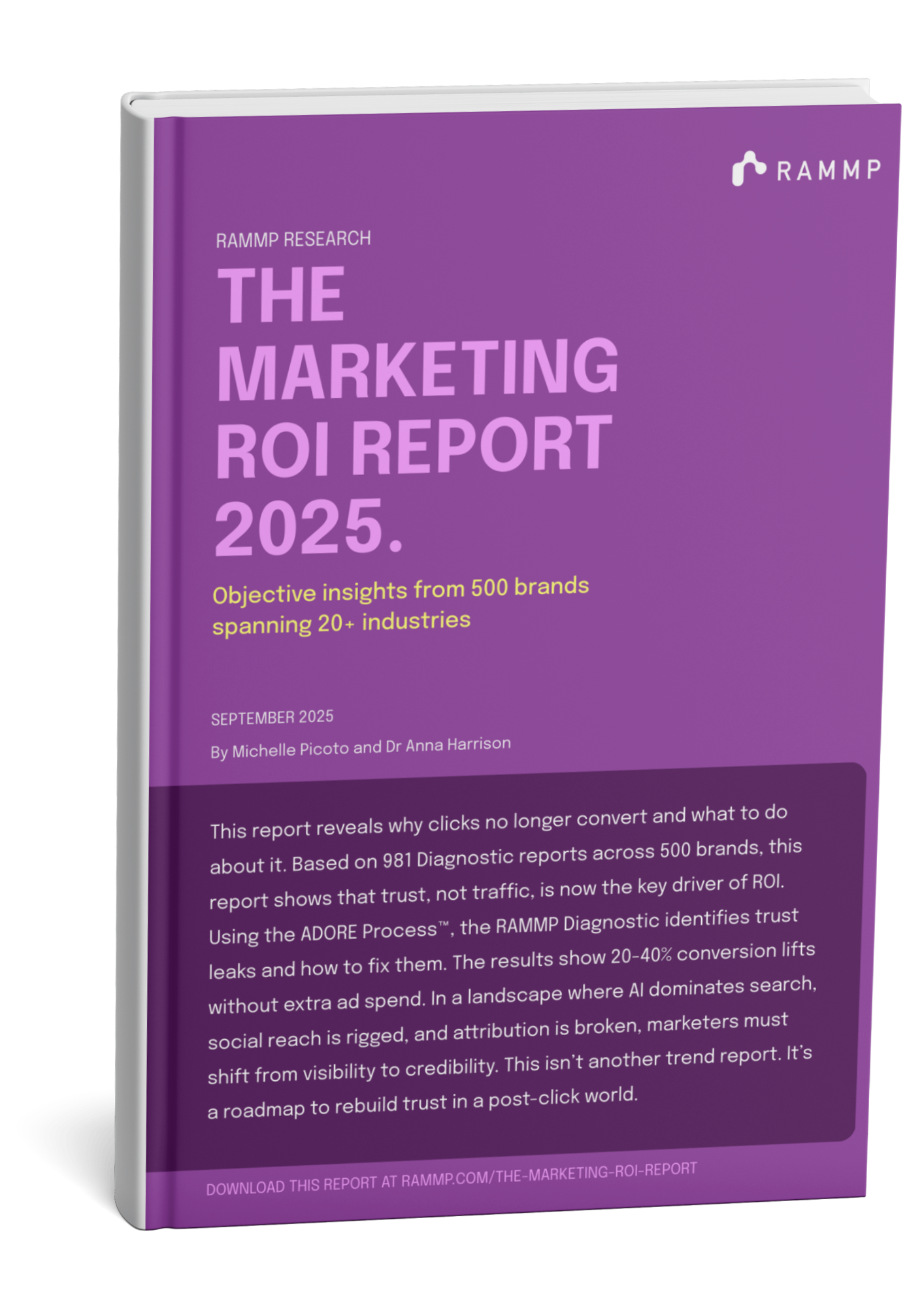
RAMMP Research
The Marketing
ROI Report 2025.
Why clicks no longer convert — and what to do about it. Objective insights from 981 RAMMP Diagnostics across 500+ brands and 20+ industries. The finding: trust, not traffic, now drives ROI.
Why this report exists
In 2025, marketing ROI collapsed.
Organic reach was cannibalised by AI. Paid media got costlier while delivering less. And executives lost confidence — only 17% trust their attribution data.
This is the first report to call it out with data, not complaints. Built on 981 RAMMP Diagnostics, it maps where spend is wasted, where value is created, and why trust has become the most predictive metric of growth.
What you'll learn
- The state of marketing ROI in 2025 — where spend is wasted and where value is created.
- The biggest failures, and the surprising wins, that shaped the year.
- Why trust is now the most predictive metric of growth.
- How the ADORE Process™ diagnoses the trust leaks that kill conversions.
- Practical strategies for 2026 — designing journeys that convert belief into ROI.
Who should read it
- CEOs and boards seeking marketing accountability.
- CMOs and marketing leaders under pressure to prove ROI.
- Founders and growth teams in SaaS, B2B, and tourism.
- Anyone tired of dashboards that look good but don't convert.
Inside the numbers
981 RAMMP Diagnostics.
- 500+ brands across 20+ industries.
- Six years of behavioural data behind every score.
- 10–40% conversion lift after fixing trust leaks — no extra ad spend.
- Foreword by John James, Founder of Hybrency.
Free download
Get the 2025 Marketing ROI Report.
Source: 981 RAMMP Diagnostics across 500+ brands and 20+ industries.
Most common trust fails revealed
What we find in the wild.
Harnessed from 981 RAMMP Diagnostics across 20+ industries.
Proposing on the first date
- What it looks like
- BOOK A DEMO, CALL US, BUY NOW in the hero — before any trust is established.
- Why it fails
- Too intimate, too fast. No trust has been built before the ask.
- Biggest offenders
- SaaS, Engineering, HealthTech
Self-obsessed monologues
- What it looks like
- Leading with features. "Our products." "We deliver." All about the brand, not the buyer.
- Why it fails
- Customers need to see how you improve their life. Not yours.
- Biggest offenders
- Pro services, tech startups, FMCG
Confusing pathways to buy
- What it looks like
- Clashing CTAs. Chaotic menus. Pop-ups on arrival. Total UX friction.
- Why it fails
- If they can't figure out how to buy, they'll buy from your competitor instead.
- Biggest offenders
- Ecomm, Gov SaaS, EdTech
Source: 981 RAMMP Diagnostics across 500+ brands and 20+ industries.
Foreword
We're well and truly past the digital marketing peak and firmly into a chase for yield on marketing investment. Search is being cannibalised by AI, yet many teams are still overly focused on their websites — over-relying on thin, low-quality content that an LLM can now generate instantly, for free.
I see teams on one side or the other of this peak, which roughly occurred in 2021. The ones on the left still have faith in "going digital": new websites, rebrands, refreshes, tech-stack changes, transformation projects, tactical AI initiatives. I call them the digital yield deniers — forever questing for the digital fix that solves everything quickly, cheaply, and easily.
The teams on the right operate differently. They've cut their websites to a bare minimum. They favour high-quality video over text-heavy blogs and product pages. Their social strategy is influencer- and collaboration-led, built on visible social and product proof. Partnerships start with content and progress into live webinars and face-to-face events — the last bastion of content AI can't fake. They're comfortable trading scale for depth of branding moments and sales impact.
What you're about to read is the first real attempt I've seen to call this out — not with complaints, but with data. The team at RAMMP has done what most don't: built an objective system that measures the moments that matter, the actual reasons someone buys or bounces. They're not offering more tactics. They're offering a map that diagnoses trust and conversion.
This report won't tell you to "post more" or "pivot to video." It will show you where trust is breaking and what to do about it. That's why I'm glad to write this foreword — not because I agree with everything (that's not my job), but because the work cuts through the noise. It's honest, it's grounded, and it reflects what many of us on the frontlines have felt for years.
Marketing doesn't need more hype. It needs more truth. You'll find a lot of it here.
— John James
What's inside